Research

Overview of active research themes, computational methods and selected projects.

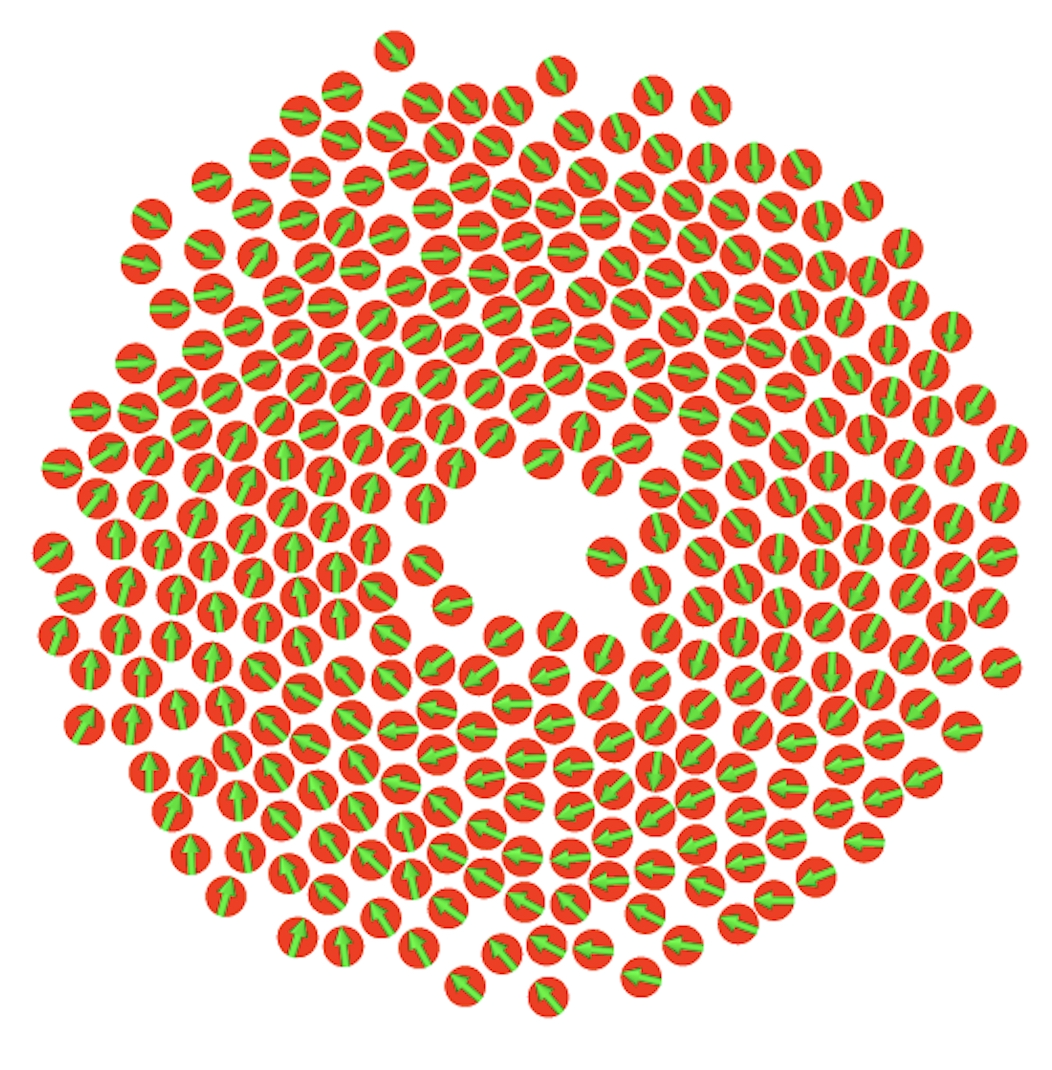
Active Matter & Collective Behaviour

Active Brownian particles, collecive behavior and emergent dynamical states.

Soft & Polymer Physics

Polymer physics and soft matter systems, with a focus on self-assembly, confinement, viscoelastic response, and collective phenomena in complex fluids.

Biophysics

Cell mechanics and cell migration, Physics of Plasmodium biology, cell deformation in constrictions, membrane dynamics and transport.

Molecular dynamics
Brownian/Langevin dynamics
Dissipative Particle Dynamics
Multiparticle Collision Dynamics
Triangulated Surface Models
Mean Field Models
Data analysis & visualization
GPU acceleration (CUDA)

Selected projects

Packing of a helical polymer into a capsid

Torsional elasticity strongly shapes how a semiflexible helical polymer packs into and ejects from a confined capsid. Mild torsional rigidity speeds up packing, while higher stiffness first slows and then accelerates it due to competition between spooling and increased persistence length—a feature that disappears without confinement. Torsional stiffness also promotes spool-like structures, whereas ejection slows monotonically as rigidity impedes uncoiling. Overall, torsional mechanics critically influence both packing and release in confined polymers such as viral DNA.
References: J. Chem. Phys. (2025); Adv. Theory & Simulations(2025)

Blood sediments as gel

Erythrocyte sedimentation arises from the collapse of a soft-particle gel formed by densely packed, deformable red blood cells with weak attractions. Experiments, simulations, and theory show that stronger fibrinogen-mediated interactions create a more porous, permeable cell network, leading to faster sedimentation. Together, these results support a gel-based mechanism rather than sedimentation of disjoint aggregates and link ESR directly to the microstructure of the erythrocyte network.
References: Phys. Rev. Lett. (2022); Phys. Rev. E (2022)

Malaria parasite alignment at RBC surface

Malaria parasites align their apex to the red blood cell (RBC) membrane through a passive process driven by stochastic adhesion bonds and RBC deformability. Simulations show that membrane deformation helps wrap the parasite and promotes apex contact, while increased RBC rigidity drastically slows alignment. Parasite shape also matters: the native egg-like form achieves reliably fast alignment across a wide range of adhesion strengths and membrane rigidities, whereas spherical, oblate, or highly elongated shapes often align more slowly. Overall, parasite adhesion, RBC mechanics, and shape jointly govern the efficiency of apical alignment required for successful invasion.
References: eLife (2021); eLife (2020); Biophysical journal (2019)

Tools & Resources

Coarse-grained MD simulators

Analysis & visualization

  • OVITO
  • MDAnalysis
  • VMD
  • Paraview
  • Python (NumPy, SciPy, Matplotlib)

High-performance computing

  • MPI & OpenMP
  • GPU / CUDA computing